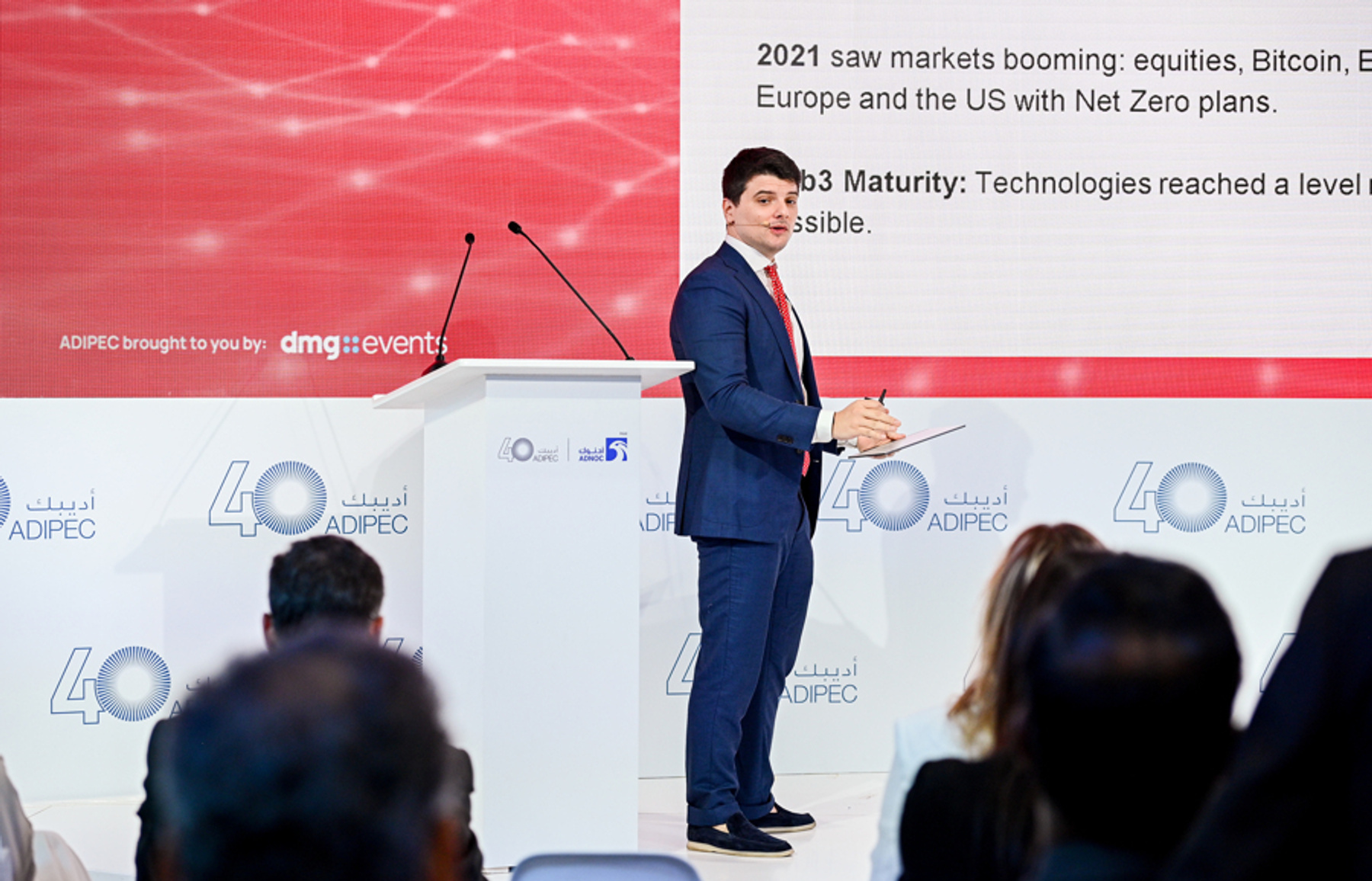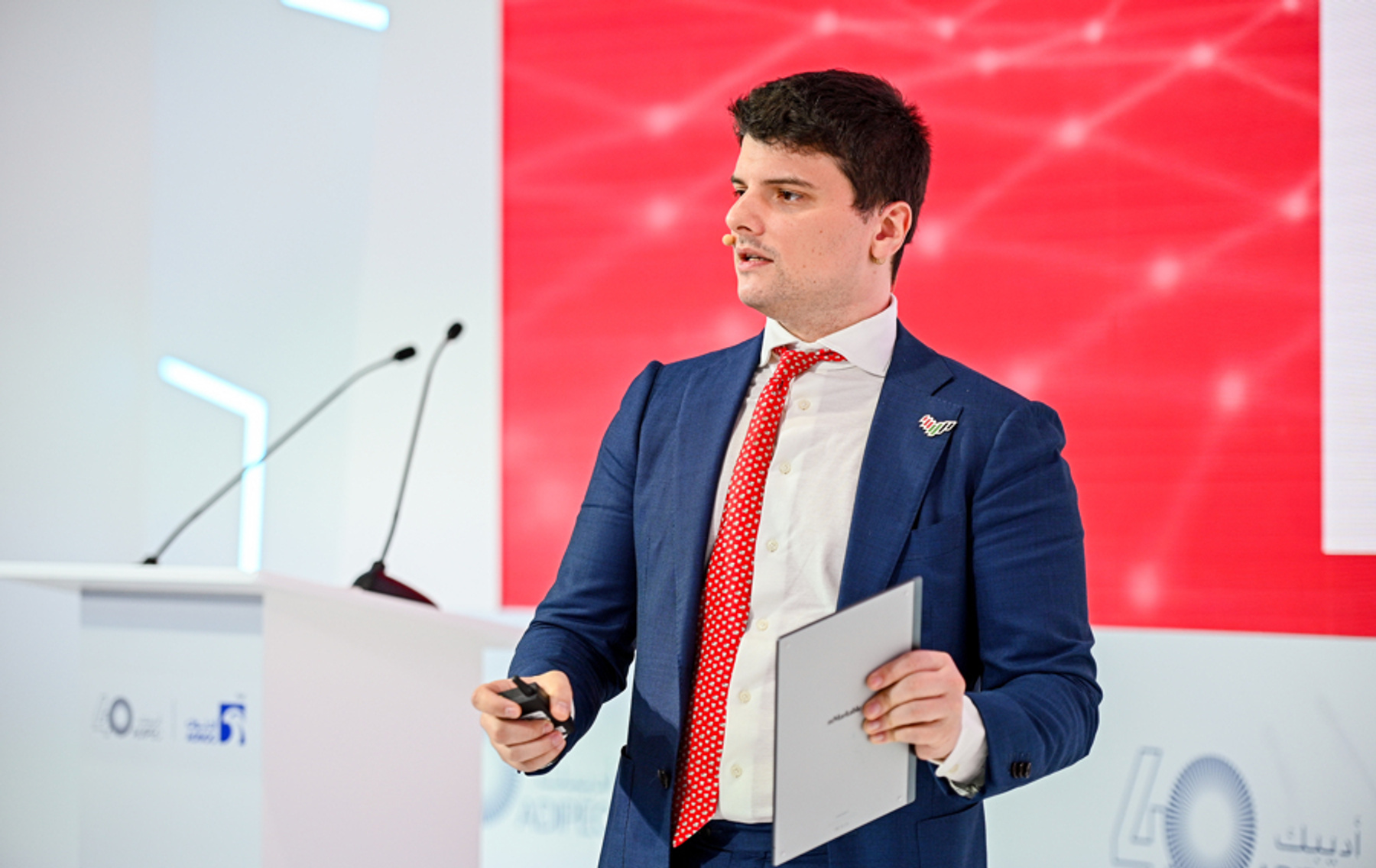
At the ADIPEC Digitalisation and Technology Conference in Abu Dhabi, Giorgio Alessandro Donà-Danioni delivered a keynote exploring how blockchain technology is transforming voluntary carbon markets. Speaking as Chairman of KCG (ADGM), the parent company of Carbonmark, he walked the audience through the structural inefficiencies that have historically constrained the voluntary carbon market (VCM) and outlined how blockchain infrastructure is resolving them one by one.
A market ready for transformation
The voluntary carbon market has long occupied a paradoxical position. On the one hand, it is the primary private-sector channel for financing climate mitigation outside of compliance regimes. On the other, it has been plagued by opacity, thin liquidity, and integrity concerns that have slowed institutional adoption and depressed prices below the level required to move new supply off the ground. At ADIPEC, Giorgio framed this as a market ready for transformation rather than a market in crisis: the demand signal is real, the project pipeline is real, and the missing layer has always been the infrastructure through which credits are issued, transferred, retired, and audited.
Structural problems the VCM has lived with for too long
The first half of the keynote enumerated the four frictions that have held the VCM back. Transparency has been limited: prices quoted in over-the-counter deals rarely match the prices at which comparable credits change hands elsewhere, and buyers have had no clean way to verify how a project's claimed tonnage was actually calculated. Operational efficiency has been poor: matching a corporate buyer to a project developer has historically required brokers, paper certificates, and weeks of back-and-forth, with retirement happening off-chain in closed registries. Double-counting risk has been real: credits issued on one registry and retired on another, or resold in bilateral deals without updating a central record, have eroded buyer confidence. And credit quality verification has been outsourced almost entirely to ratings firms and standard-setters, leaving buyers dependent on centralized judgments about projects they cannot inspect directly.
What blockchain actually solves
The second half of the keynote argued that each of these frictions has a direct architectural answer in blockchain infrastructure. An immutable ledger gives every tonne of carbon a traceable provenance: project, vintage, methodology, serial number, and every transfer it has been part of, all visible to anyone with a block explorer. Smart-contract retirement collapses settlement windows from weeks to seconds, and the retirement is simultaneously the proof: once a credit is burned on-chain, it cannot be moved, double-counted, or quietly resold. Decentralized marketplaces remove the informational asymmetries that favored intermediaries, giving project developers, corporate buyers, and institutional investors the same pricing and supply data. And on-chain liquidity pools - such as those pioneered by KlimaDAO - provide depth with minimal slippage, converting the VCM from a market of bilateral negotiations into a market of continuously quoted spot prices.
The Carbonmark case
Giorgio used Carbonmark as the worked example throughout the session. Carbonmark sits on top of the tokenization stack built by KlimaDAO and presents a single venue where tokenized credits from multiple standards and registries can be browsed, purchased, and retired. Carbonmark's role in the ecosystem is that of the regulated-grade storefront: it absorbs the complexity of on-chain registry integration and translates it into a workflow that a sustainability officer at a Fortune 500 company can use without ever having to touch a wallet. The keynote positioned this as the missing middleware layer that bridges the on-chain supply built by protocols like KlimaDAO to the traditional demand-side of corporate buyers and institutional treasuries.
What comes next for the industry
The closing section of the keynote looked forward. For blockchain-native carbon infrastructure to move from proof-of-concept to mainstream financial plumbing, three things have to happen in parallel. Usability has to improve: the interfaces that retail and enterprise buyers interact with must look and behave like any other modern SaaS product, with the blockchain rails invisible underneath. Collaboration has to deepen: policy-makers, climate scientists, standard-setters, and technologists need to build shared frameworks that let on-chain credits interoperate with the Article 6 mechanisms emerging from COP28 and with the compliance markets that are now integrating voluntary supply. And product innovation has to continue: price stability mechanisms, structured products, and new blockchain applications in measurement, reporting, and verification all remain open fields.
ADGM as the regulated hub
Giorgio closed with the regional angle. Abu Dhabi Global Market has become one of the most credible common-law financial centres for digital assets and environmental commodities globally. KCG is incorporated at ADGM by design: the jurisdiction offers a registered entity, a regulator with a clear stance on virtual assets, and immediate proximity to the sovereigns, commodity houses, and institutional capital that will move tokenized carbon from a crypto-native curiosity to an asset class on the balance sheet of every multinational. With COP28 having taken place at Expo City Dubai just a year earlier, the Gulf is now positioned as the natural hub for the next phase of the voluntary carbon market.
Key takeaways
Blockchain's entrance into the carbon credits industry is more than a technological upgrade - it is a change in the way environmental markets can operate. By addressing transparency, efficiency, double-counting, and credit-quality verification simultaneously, the infrastructure is creating the conditions for a genuinely global, liquid, and auditable voluntary carbon market. The remaining question is not whether blockchain reshapes the industry, but how quickly, and which regulated jurisdictions will capture the long-term value of hosting that infrastructure.
From the event